The Many Selves I'm Living: I Miss Being in the AAPI Universe
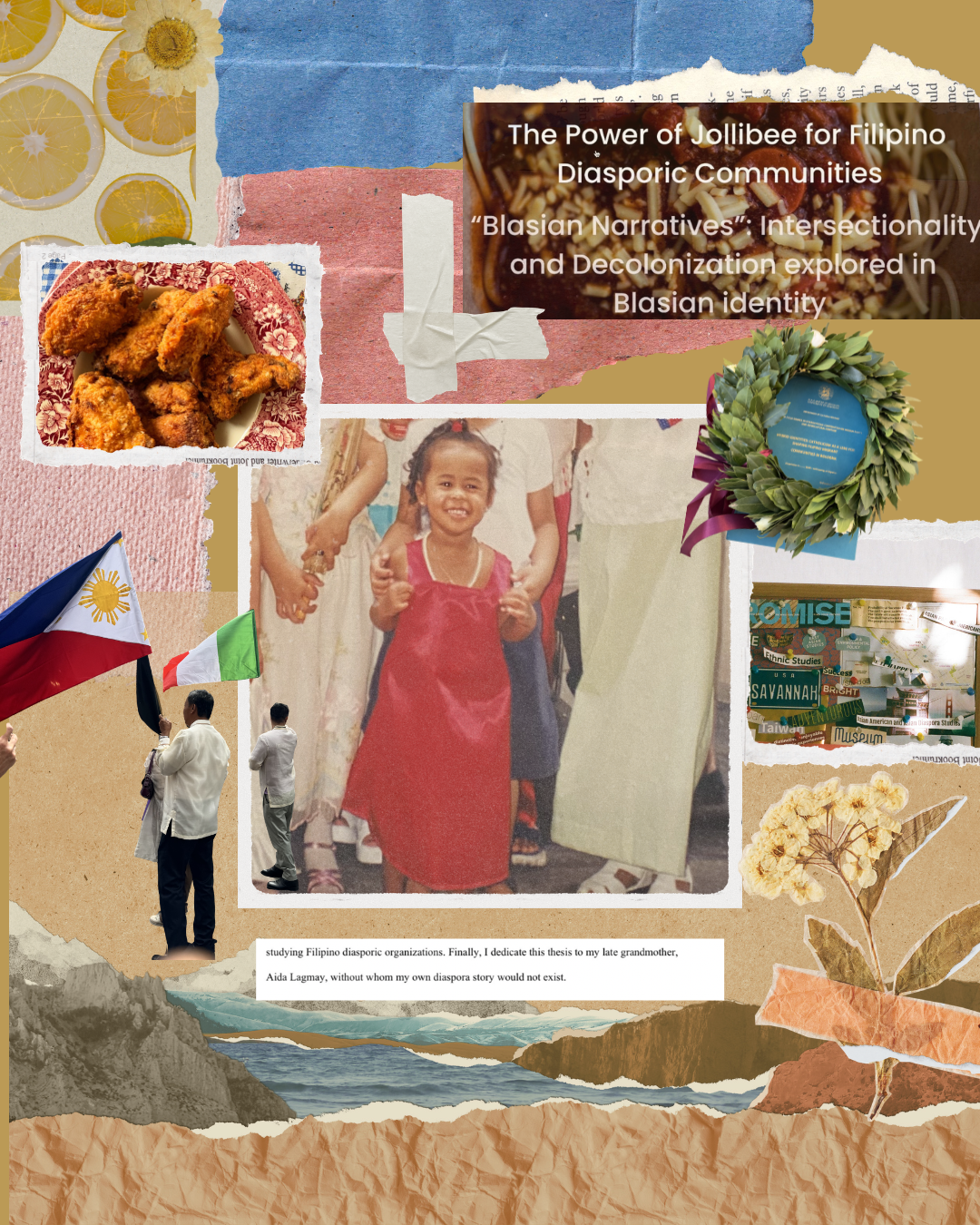
Depicted: Me in 1999 at the NYC Filipino Parade, a vision board that came true, my thesis, and other essays.
In the light of AAPI Heritage Month, I miss being Asian American in the same way you miss your favorite dish abroad. I could go to Roadhouse in Italy for ribs, but is it really the same? No! Whether that means kicking it with my best friend in Queens or with fellow AAPIs in Tokyo — I miss the late 2010s of discussing representation politics, East Asian hierarchy, and just connecting over being Asian American. And even more niche: who can I talk to about the overrepresentation of Wasians? I miss being understood that way.
And I miss being Filipino American. While my research was on the Filipino diaspora in Italy and I explored those communities firsthand, I felt like Paulie in The Sopranos when he went to Naples — the gap between being Italian and Italian American made visible. The same thing happened in Japan, when I mentioned that my mom puts Goya seasoning in the adobo and someone looked at me blankly: what is that?
In Italy, I am American, African (people scratch their heads when I can't tell them exactly where), and Filipino. Ironically, Italians are the only ones who pronounce my middle name correctly: Lag-Mai not Lag-MAY. In the US and to a degree in Japan, I'd always lead with my ethnicities. In Europe? I barely relay that information unless I get the "where are you really from?" For the past three years, I've been knee-deep in the western imaginary of whiteness without the social circles I'm familiar with. It's another language, literally at times. I miss those inside jokes. The collective understanding. Being in the AAPI universe.
Two years ago I took a 23andMe test — a birthday gift. Two years later, as the company changed (and we all know that drama), I received my most updated results: 50.2% Filipino, 37.4% Sub-Saharan African, 11.8% British & Irish. It made me think about how far I've come from having to prove myself in Asian American spaces. Being an "exceptional" representation of my Filipino and Asian Americanness is a mentality that has permeated every facet of my life — or maybe I've simply experienced too much identity burnout. The 2000s were the best of times and the worst of times. We had iPods, but you couldn't find curl products at Target. You don't have Asian features — the surface of the iceberg for a child who never felt enough. There's discourse now about the post-COVID world being too connected, but do I really miss living in a world that enforced the idea that I shrink myself to fit in? Ethnic studies literature, Reddit threads, and Substacks are far more accessible to a thirteen-year-old today than they were ten years ago.
Am I simply reaping the benefits of years of doubling down on my Filipinoness? Anthropology exams, ethnographies, a master's thesis — hair straightened to death — apparently that's enough. I remember fighting tooth and nail, nearly teary-eyed in Asian American spaces. The fight to be seen and when you are, it's like the weight of groceries you were carrying all day that you can finally put down. The fight for legitimacy. As the "jungle Asian" in broader East Asian spaces, but also the Black girl who is Filipino. Filipino-American and even more so Asian American spaces are at times a house and other times a home: where I identify the most and feel seen, while sometimes not entirely welcome.
Back then, if someone could tell I was Filipino, I felt seen — but almost too seen. Now when I encounter Filipinos on the bus or in Lidl who clock it immediately, I'm a little surprised. Huh. I do look Asian after all. If I really wanted to stand on business, I'd learn Tagalog and Ilocano — the former practically a second language anyway, given that I can hear it within earshot in many Italian cities that are home to the largest Filipino communities in Europe.
Ironically, 29 years later, someone finally criticized me for not being Black enough — suggesting that being raised by a single Asian mother was a detriment because I wasn't socialized as Black. They aren't entirely wrong. I shrug. Blackness is inescapable and yet I wasn't raised much within African American culture. A classmate from Côte d'Ivoire looked at me with skepticism when I explained I genuinely didn't know exactly where in Africa my father's ancestry is from. This is also a familiar trope for mixed kids: the dad is usually non-Asian, and you're raised by that one parent (even if they are technically still married) — spoiler alert, it's usually the mom.
But perhaps the further I am from America, the less there is to prove — because there's hardly an audience that understands anyway. The bigger elephant is not being Japanese, is not being Italian. There is almost nothing to perform here, except maybe the role of an immigrant in a foreign land.
Which makes me wonder: do I miss being Asian American, or do I miss the performance of it — in all its highs and lows? In Asia, the transnational tie to America is within an arm’s grasp: it lives in our families' stories, direct and ongoing. But how do I make that tie in Europe? There is diaspora beyond the North American narratives and even beyond its transpacific tie. I've encountered Filipino-Italians, have Filipino-British relatives. It's not a direct line. Perhaps it's a thread still in the making.